The Mind Needs Logs

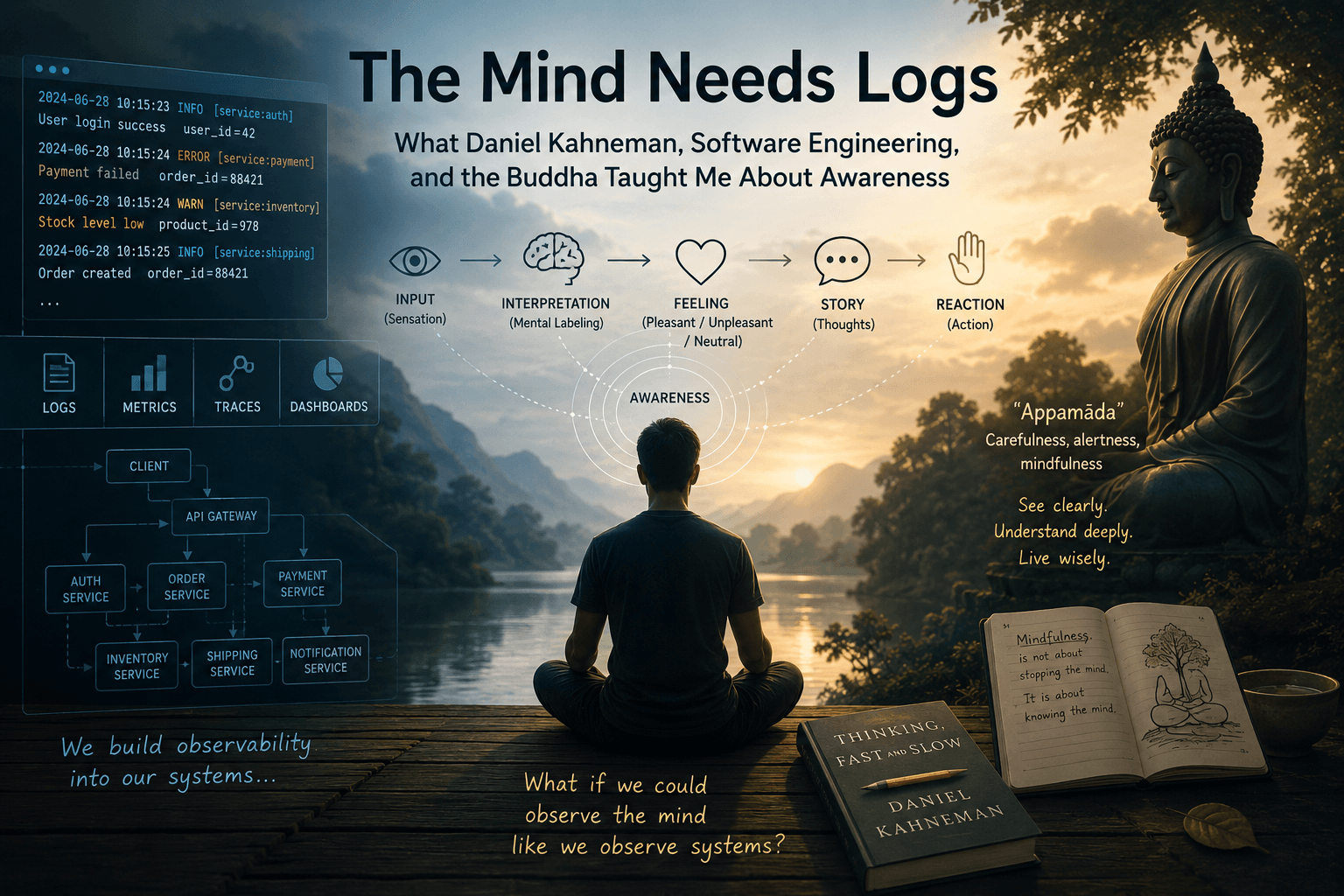
The Mind Needs Logs
When I first learned about the Buddha, one thing never made sense to me.
How did he become enlightened?
People would say,
“He sat under a tree.”“He meditated.”“He observed his mind.”
That’s all?
The explanation always felt... incomplete.
As a software engineer, I’ve spent years building systems, debugging distributed services, and tracing requests across dozens of components. I know how difficult it is to understand a complex system—even when I wrote the code myself.
So how could simply watching your thoughts reveal something profound about reality?
It sounded too passive.
Too simple.
Then I read Thinking, Fast and Slow by Daniel Kahneman.
And suddenly, meditation no longer looked simple.
It looked like one of the most sophisticated debugging techniques ever invented.
We Monitor Everything... Except the Most Complex System We Own
Modern software is impossible to maintain without observability.
We collect logs.We monitor CPU usage.We trace requests.We record metrics.We build dashboards.
Because every engineer eventually learns the same lesson:
When a system behaves unexpectedly, the first question isn’t:
“How do we fix it?”
It’s:
“What actually happened?”
Without logs, we’re left guessing.
Without observability, every bug becomes a mystery.
Then I realized something unsettling.
I spend countless hours making software observable.
Yet the system generating every thought, emotion, and decision I experience remains largely invisible to me.
My own mind.
Reading Kahneman made me realize something uncomfortable.
Perhaps the most sophisticated system I’ll ever encounter isn’t one humans invented.
It’s the one evolution has been building for millions of years.
Your Brain Is Running More Code Than You Think
One of Daniel Kahneman’s biggest contributions was showing that much of what we call thinking happens automatically.
He described two modes of thought as System 1 and System 2.
Most of the time, they work together so seamlessly that we don’t even notice the difference.
Until we start looking.
Imagine someone says:
“Peanut butter and...”
You probably thought, “Jelly.”
No effort. No reasoning.
The answer simply appeared.
Or if I ask:
What is 2 + 2?
You don’t consciously calculate. You just know.
That’s System 1.
Fast. Automatic. Effortless.
It recognizes faces, finishes familiar sentences, detects patterns, forms first impressions, and generates intuitions.
When a child suddenly runs into the road, you may hit the brake before conscious reasoning even begins.
Now try multiplying:
27 × 43
Something changes.
You slow down. You hold numbers in your head. You check your work.
That’s System 2.
It reasons. Questions assumptions. Plans. Calculates.
But it comes at a cost.
System 2 requires effort, so the mind tends to rely on automatic processes whenever it can.
Most of the time, System 1 generates impressions, feelings, and intuitions before we consciously examine them.
And System 2 often receives the conclusion without investigating where it came from.
That is what fascinated me.
The mind is constantly doing things before the conscious mind gets involved.
A thought appears.
A feeling appears.
An interpretation appears.
And then, very quickly, it feels like I thought it.
But what if the thought is an event?
What if the feeling is an event?
What if the interpretation is an event?
And what if I could learn to see these events as they happen?
That was when Buddhism started making sense to me.
Appamāda
One word appears again and again throughout the Buddha’s teachings:
Appamāda.
It has been translated as heedfulness, vigilance, carefulness, and non-negligence.
No single English word fully captures it.
In the Mahāparinibbāna Sutta—the traditional account of the Buddha’s final days—the Buddha’s final exhortation is commonly rendered along the lines of:
“All conditioned things are subject to decay. Strive on with appamāda.”
At first, I couldn’t understand why this mattered so much.
Why end an entire lifetime of teaching with an idea that sounds like:
“Don’t be careless.”
After reading Kahneman, I began to understand it differently.
Kahneman helped me see why automatic thinking exists.
Appamāda is a practice of not being negligent about what happens in the mind.
Not to stop every thought.
Not to suppress every emotion.
Not to judge every reaction.
Simply to see clearly what is happening.
Before it becomes action.
Before it becomes speech.
Before a passing thought becomes a belief.
Before irritation becomes anger.
Before fear becomes certainty.
Awareness Is Observability
Engineers know an important principle:
The earlier you observe an event, the easier it is to understand the system.
If a request fails, we don’t inspect only the final error message.
We trace it back to where it entered the system.
We ask:
Where did it begin?
What happened next?
Which component transformed it?
Where did the unexpected behavior first appear?
Buddhist psychology begins with a surprisingly similar model.
Experience arrives through what are traditionally called the six sense doors.
Five are exactly what you’d expect:
Sight.Sound.Smell.Taste.Touch.
The sixth surprised me.
The mind itself.
Thoughts are treated as objects of awareness, much like sounds are objects of hearing or sights are objects of seeing.
That completely changed how I looked at meditation.
If thoughts are events, then they don’t automatically deserve my trust simply because they appeared.
Some are useful.
Some are misleading.
Some are memories.
Some are predictions.
Some disappear as quickly as they arrive.
The moment I assume every thought is “me” or “mine,” I’ve stopped observing the system and started identifying with one of its outputs.
If I were drawing the pipeline, it might look something like this:
Eye sees criticism↓Memory retrieves similar experiences↓Mind generates an interpretation↓Emotion begins↓Reaction follows
Most of us don’t become aware until the final step.
By then, we’re already explaining why we became angry.
But the real process happened much earlier.
An engineer would ask:
Where should we place the logs?
As early as possible.
Observe the incoming event.
Observe the interpretation.
Observe the first emotional signal.
Observe the impulse to react.
Meditation, seen this way, isn’t necessarily about rewriting the code.
It’s about increasing the logging level.
The system doesn’t suddenly become different.
You simply begin seeing what it has been doing all along.
Reading the Logs
A few weeks after reading Kahneman, I noticed something small.
Someone replied rather bluntly to one of my messages.
Almost immediately, my mind started generating a story.
“They’re annoyed.”
“Maybe I offended them.”
“I should explain myself.”
Then something unusual happened.
I noticed the story before I believed it.
It felt strangely familiar.
Like opening a log file before a production incident escalated.
There it was.
Input received.
Interpretation generated.
Emotion initializing...
Nothing magical happened.
I still felt defensive.
But because I had seen the process unfolding, it no longer felt inevitable.
There was a small gap.
Just enough space to choose a different response.
That tiny moment taught me more about Appamāda than any definition ever could.
The important thing wasn’t that I stopped the thought.
I didn’t.
The thought still happened.
The emotion still happened.
What changed was that I could see it happening.
And once I could see it, I didn’t have to immediately become it.
The Most Sophisticated System You’ll Ever Observe
As engineers, we admire computers because they execute billions of operations every second.
But reading Thinking, Fast and Slow left me with a different kind of appreciation.
The most sophisticated information-processing system I interact with every day isn’t my laptop.
It’s the biological system inside my own skull.
It predicts.
Filters.
Recognizes patterns.
Constructs stories.
Generates emotions.
Makes decisions.
And most of it happens before “I” even realizes it’s happening.
Maybe that’s why the Buddha spent so much time studying the mind.
Not because the mind is mystical.
But because it may be the most complex system any of us will ever encounter.
And unlike the software systems we build, we can’t simply shut it down and inspect the source code.
We have to observe it while it is running.
That may be what makes meditation so difficult.
And so powerful.
Today, when I think about Appamāda, I no longer translate it simply as “mindfulness” or “heedfulness.”
I think of it as something closer to observability.
The quiet discipline of watching a complex system closely enough that, when something goes wrong, you can see where it began.
Not after the anger.
Not after the argument.
Not after the decision.
But at the beginning.
At the moment the input arrived.
At the moment the story appeared.
At that moment the emotion began.
At the moment the impulse to react emerged.
Because before you can change the system...
you first have to see it.
Comments
Sign in to join the conversation.